

for Used Car and BHPH Dealers
Your technology stack should make operations smoother, profits clearer, and teams stronger. Our dealer technology training and education content is built for independent used car, buy here pay here, lease here pay here, and subprime operators who want practical, step by step guidance. Learn how to evaluate and integrate dealer management systems, customer relationship management platforms, digital retail tools, payment processors, telematics, and analytics so every process is measurable and scalable. We focus on real workflows that improve collections, underwriting, inventory turns, payment performance, and compliance readiness. Explore road tested frameworks, templates, and case examples you can apply immediately across sales, service, accounting, and portfolio management. For deeper dives on related topics, visit dealer-workshops-and-training and dealer-performance-optimization-education. The resources below are designed to match technology decisions with your business model, market, and growth plan so you can deploy systems that your team actually uses and your customers value.
Use this page to register members of your dealership ASAP!
ONLY $299 For Each Addt'l Dealership Attendee
CAESARS ROOMS DISCOUNTED TO $189 a night
(Plus Resort Fee)
This page consolidates best practices, integration playbooks, and training paths tailored to dealership size and strategy. Whether you run a single rooftop or multi location network, you will find clear standards for data integrity, system mapping, staff skills, and day to day performance management. Use the internal links to expand into compliance, collections, leadership, and operations content as you refine your tech roadmap.

What Dealer Technology Training and Education Covers
Dealer technology training and education aligns people, process, and platforms across the retail and finance lifecycle. For independent used car and buy here pay here operators, the right stack turns complex tasks into consistent, auditable routines. It reduces busy work, improves decision quality, and speeds up execution. This page explains the essential systems to master, how to connect them, and how to teach your team to use them with confidence.
Core Systems Your Team Should Master
A strong technology foundation starts with clarity about the role of each application and how data moves across the customer and vehicle journey. Use this checklist to benchmark your current tools and identify gaps.
- Dealer Management System for inventory, deals, titles, recon, accounting handoffs, and reporting
- Customer Relationship Management for lead capture, follow up automation, appointment setting, and sales pipeline health
- Digital Retailing for online credit apps, trade valuations, soft pulls, and e contracting readiness
- Payments and Collections for omni channel payments, autopay, reminders, and delinquency workflows
- Telematics and GPS for asset tracking, payment performance support, and recovery rules management
- Service and Reconditioning for work order control, parts, technician productivity, and cost to market visibility
- Accounting and Reconciliation for source of truth financials, audit trails, and loan level accuracy
- Business Intelligence and Dashboards for real time KPIs, cohort analysis, and portfolio risk alerts
Education Paths by Business Model
Different models call for different technology emphasis. Explore role specific training and playbooks to accelerate adoption and accountability.
- Buy Here Pay Here technology integration education for payment performance, collections cadence, and portfolio risk rules
- Lease Here Pay Here technology integration training for lease structure, returns, and service coordination
- Subprime technology integration training for underwriting automation and lender communication
- Used car dealer technology integration training for inventory sourcing, pricing strategy, and recon control
Compliance, Security, and Audit Readiness
Modern dealership operations rely on accurate, protected data. Training should hard wire compliance into systems and daily routines, not treat it as an afterthought. Establish permission structures, multi factor authentication, encryption standards, data retention policies, and audit logs across your DMS, CRM, payments, and telematics platforms. Use written procedures that map each regulation to specific fields, forms, timestamps, and reports so your systems prove what your policies promise.
- Dealer compliance best practices to align workflows with regulation
- Federal compliance training for dealers to standardize documentation and disclosures
- State compliance education for dealers to address local requirements and audits
- Buy Here Pay Here federal compliance education for in house finance controls
Integration Playbook
Technology only delivers value when data flows and tasks are automated end to end. Use this phased approach to reduce risk and accelerate time to value.
- Define process map from lead to title to payoff and mark each system of record
- Create a data dictionary with field names, owners, validation rules, and retention timelines
- Pilot integrations with a small user group and a narrow set of tasks to refine steps and permissions
- Build dashboards tied to weekly operating routines and publish definitions for every KPI
- Formalize training with job aids, screen recordings, and role based checklists
Team Enablement and Skills Development
Adoption happens when training is relevant to the job, easy to access, and reinforced by leadership. Pair short live practice sessions with asynchronous micro lessons your staff can replay on demand. Reinforce correct usage in one on ones and performance reviews. Promote system champions in each department and give them time to coach others. Align incentives with data quality and process compliance, not just end results.
- Dealer HR training education for onboarding and role clarity
- Dealer leadership development training for coaching and accountability systems
- Dealer sales training education to connect CRM usage to appointment and close rates
Use Cases by Department
Training should mirror the daily flow of work. The scenarios below provide practical starting points to build confidence and momentum.
- Sales and Marketing - connect marketing source to lead, appointment, write up, and funding. See dealer-marketing-training-education for attribution and campaign setup.
- Underwriting - standardize application review, stips, deal structure, and decision rules. Visit dealer-underwriting-education for scorecards and audit trails.
- Collections - implement contact cadence, promise to pay tracking, and queue management. Explore dealer-collections-training and buy-here-pay-here-collections-best-practices.
- Service and Recon - schedule work, capture parts, and control cycle time. See used-car-dealer-service-operations-training for technician productivity.
- Accounting - automate reconciliations and loan level accuracy. Review dealer-accounting-training-education for month end close steps.
KPIs and Dashboards That Matter
Teach teams to read the scoreboard and act on it. Dashboards should fit the meeting rhythm and contain only metrics the team can influence. Pair each KPI with an owner, a target, and a standard countermeasure when trends slip.
- Lead to appointment rate, show rate, and closing rate by channel and salesperson
- Inventory aging, price to market, and recon cycle time with alerts on cost creep
- Delinquency buckets, roll rates, and right party contact coverage by account segment
- Charge off rate, recovery rate, and total loss severity with GPS and collateral data overlays
- Gross per copy, product penetration, and funding velocity for cash flow predictability
Deepen your metrics toolkit with dealer-performance-optimization-education and buy-here-pay-here-portfolio-performance-training. For payment outcomes, visit buy-here-pay-here-payment-performance-education.
Implementation Timeline You Can Trust
Speed matters, but accuracy protects profits. A typical rollout timeline balances quick wins with careful data stewardship. Use this framework and adapt it to your store count and staffing levels.
- Weeks 1 to 2 - discovery, process mapping, security plan, and data dictionary
- Weeks 3 to 4 - system configuration, user permissions, integrations, and pilot scripts
- Weeks 5 to 6 - team training, role based checklists, and KPI dashboards live
- Weeks 7 to 8 - stabilization, issue backlog burn down, and audit readiness review
Common Pitfalls and How to Avoid Them
- Too many tools with overlapping features - standardize on a core stack and retire duplicates
- Unclear ownership - assign a single data or process owner per metric and workflow
- Training once then forgetting - schedule recurring refreshers and scorecard reviews
- No audit trail - enable logs and retain proof for every key decision and disclosure
Workshops and Real World Practice
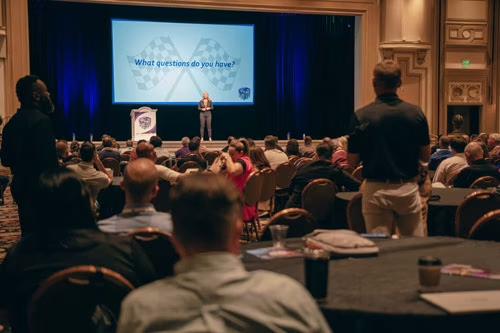
Learning sticks when teams solve real issues with their own data. Hands on workshops pair your process map with role play, sandbox environments, and scenario based drills. That is why dealership peers value interactive formats alongside on demand libraries and templates. Explore dealer-workshops-and-training for practical sessions and dealer-practical-training for implementation playbooks. For advanced topics, see dealer-advanced-operations-training.
Helpful Internal Links
Dealer Technology Training and Education FAQs
BHPH United
Login